

Compostable Postage Bags are an environmentally conscious packaging solution designed for shipping clothing, accessories, lightweight retail products, and e-commerce orders. Made from specially formulated compostable materials, these bags are designed to break down under specific composting conditions rather than remain as conventional plastic waste.
With the rapid growth of online shopping and international e-commerce, businesses are increasingly looking for packaging alternatives that can help reduce their environmental impact. Compostable mailing bags provide an option for brands that want to combine practical shipping performance with more responsible packaging choices.
As a professional flexible packaging manufacturer, we offer customized compostable postage bags in different sizes, thicknesses, colors, and printing designs. Businesses can select suitable material formulations, adhesive closures, and branding options according to their packaging requirements and applicable compostability standards.
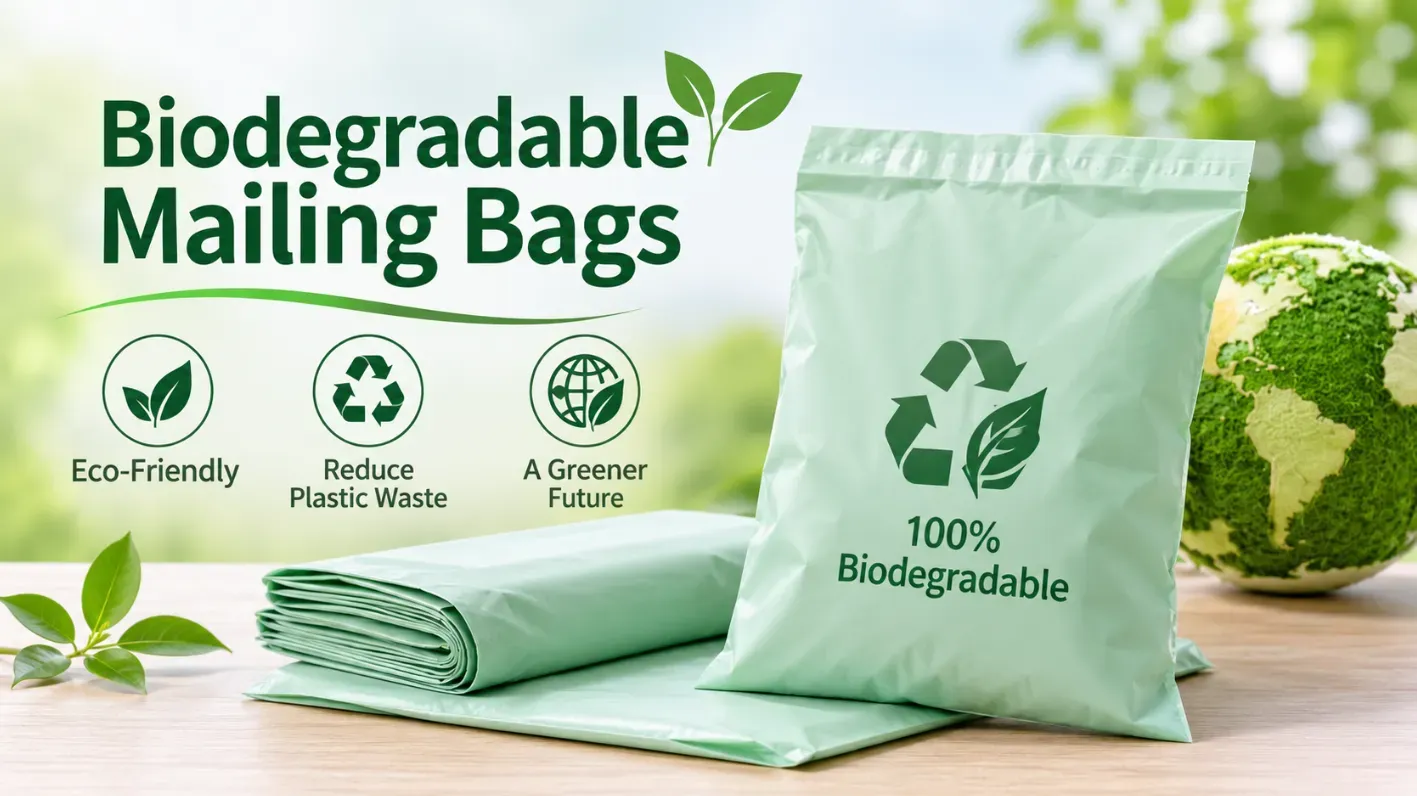
Key Takeaways
Eco-Conscious Packaging: Designed to break down under specified composting conditions.
Compostable Materials: Common formulations include PLA, PBAT, and starch-based blends.
Lightweight Construction: Suitable for shipping clothing, accessories, and lightweight products.
Moisture Resistance: Provides protection against normal moisture exposure during transportation.
Custom Printing: Supports customized logos, brand names, and packaging designs.
Multiple Sizes: Available in different dimensions and thicknesses.
Flexible Applications: Suitable for e-commerce retailers, fashion brands, and online stores.
Certification Options: Can be manufactured using formulations that meet applicable industrial or home composting standards.
Compostable Postage Bags: Context and History
Traditional plastic mailing bags have been widely used in the packaging and logistics industries because they are lightweight, flexible, affordable, and convenient for shipping.
However, growing concerns about plastic pollution and the accumulation of packaging waste have encouraged businesses to explore alternative materials.
The development of compostable packaging has introduced new material technologies, including biodegradable polymers, bio-based plastics, and starch-based compounds. These materials can be formulated to achieve specific compostability requirements while maintaining the flexibility needed for packaging applications.
Today, Compostable Postage Bags are becoming an option for e-commerce businesses, fashion retailers, and brands seeking packaging solutions that support their sustainability strategies.
Material innovation and internationally recognized compostability standards have also helped improve the reliability and transparency of compostable packaging products.
What Are Compostable Postage Bags?
Compostable Postage Bags are flexible mailing envelopes manufactured from materials designed to biodegrade under controlled composting conditions and meet specific compostability requirements.
Unlike conventional polyethylene mailing bags, compostable versions typically use specially formulated polymer blends, such as PBAT, PLA, and modified starch materials.
These bags generally feature a self-adhesive sealing strip, allowing users to close packages quickly without additional packaging tape.
Depending on the formulation and intended application, compostable postal bags can offer:
Flexible and lightweight construction.
Suitable tear resistance for lightweight shipments.
Moisture resistance.
Customizable colors and printing.
Permanent adhesive closure.
Different sizes and thicknesses.
It is important to understand that biodegradable and compostable are not exactly the same. A compostable product must meet defined requirements for biodegradation, disintegration, and other relevant testing criteria under specified conditions.
The Importance of Compostable Postage Bags in Food and Commercial Packaging
Although compostable postage bags are primarily designed for mailing and shipping applications rather than direct food contact, they play an important role in the wider sustainable packaging industry.
For e-commerce brands, packaging is not only a protective material but also an important part of their environmental and brand communication strategies.
Businesses that use compostable mailing bags may benefit in several ways.
1. Supporting Sustainable Packaging Strategies
Compostable packaging can help companies explore alternatives to conventional plastic mailers as part of their packaging improvement plans.
2. Improving Brand Image
Eco-conscious packaging can communicate a company's commitment to responsible material selection and environmental awareness.
3. Meeting Customer Expectations
Some consumers and retailers actively look for packaging made from certified compostable materials.
4. Supporting Packaging Innovation
The use of compostable polymers encourages the development of alternative material formulations and packaging structures.
5. Providing Practical Shipping Solutions
When properly designed, compostable postage bags can offer the flexibility, convenient sealing, and lightweight construction required for everyday shipping.
Businesses should always communicate the correct composting conditions to customers instead of suggesting that every compostable mailer can decompose in ordinary outdoor environments.
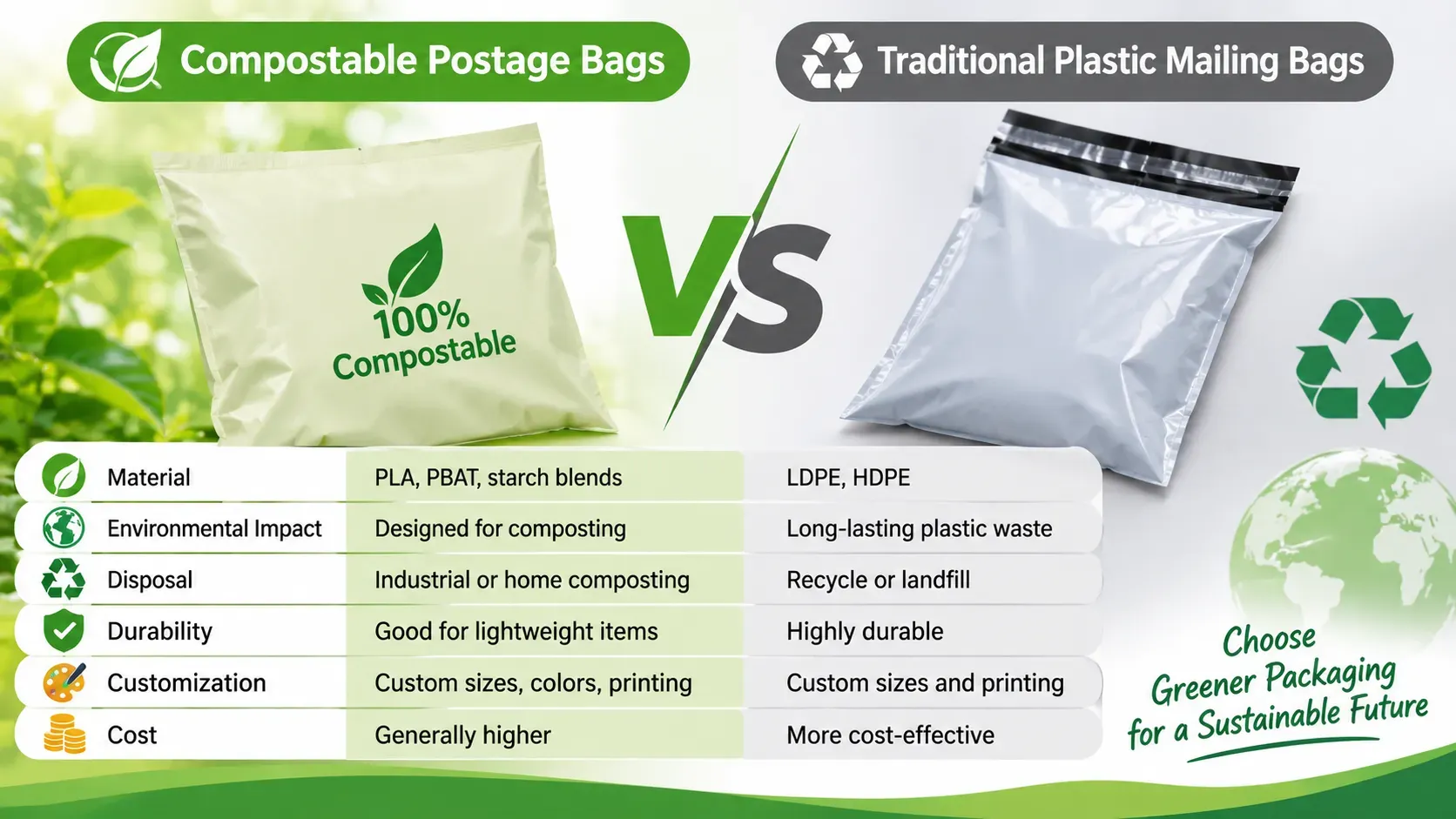
Compostable Postage Bags vs. Traditional Plastic Mailing Bags
Both compostable postage bags and conventional plastic mailing bags are used for e-commerce packaging. However, they differ in material composition, disposal requirements, and environmental characteristics.
| Comparison | Compostable Postage Bags | Traditional Plastic Mailing Bags |
|---|---|---|
| Main Materials | PBAT, PLA, starch blends | LDPE, HDPE, PE blends |
| Environmental Design | Designed for composting under specified conditions | Generally designed for durability and conventional use |
| Disposal | Industrial or home composting, depending on certification | Reuse or appropriate plastic recycling systems |
| Flexibility | Depends on material formulation | Generally good |
| Moisture Resistance | Formulation-dependent | Generally good |
| Printing | Custom logo and graphic printing | Custom logo and graphic printing |
| Shelf Life | Requires suitable storage conditions | Generally longer under normal storage |
| Applications | E-commerce and lightweight retail shipping | E-commerce, retail, and general shipping |
Which Type Should Businesses Choose?
The choice depends on product requirements, target markets, disposal infrastructure, and packaging budgets.
Compostable postage bags may be suitable for brands with established composting communication and access to appropriate composting facilities.
Traditional PE mailing bags may be more practical when durability, long-term storage, established recycling systems, and lower material costs are the primary considerations.
Neither option is automatically environmentally preferable in every situation. Businesses should evaluate the full packaging lifecycle and local waste-management conditions before making a purchasing decision.
Using Compostable Postage Bags for Storage and Packaging
Compostable mailing bags are designed for packaging and shipping a variety of lightweight products.
Their flexible construction makes them convenient for businesses that process large numbers of online orders.
Common packaging uses include:
Clothing and apparel packaging.
T-shirts, leggings, and underwear.
Fashion accessories.
Scarves and lightweight textiles.
Small retail products.
Promotional merchandise.
Non-fragile e-commerce orders.
For products requiring additional protection, businesses can combine compostable mailing bags with suitable inner packaging.
For example, clothing can be folded and placed inside the bag before the adhesive flap is sealed.
For fragile items, additional protective packaging should be used because standard compostable postage bags do not provide the cushioning protection of padded mailers.
Composition: Biodegradable and Bio-Based Materials
The material composition of compostable postage bags is an important factor affecting their flexibility, strength, and compostability.
Different polymers may be blended to achieve the required packaging performance.
Some materials come from renewable biological resources, while others may be produced from fossil-based raw materials but are designed to biodegrade under specified composting conditions.
Therefore, bio-based and compostable should not be treated as interchangeable terms.
For example, a bio-based plastic is not necessarily compostable, and a compostable polymer does not necessarily contain 100% renewable raw materials.
Manufacturers should select material formulations based on the intended application and the compostability certification required by the target market.
Common Materials Used in Compostable Postage Bags
1. PLA (Polylactic Acid)
PLA is a bio-based polymer commonly produced from renewable resources such as corn starch or sugarcane-derived sugars.
It is frequently used in compostable packaging formulations. However, PLA generally requires appropriate industrial composting conditions to achieve the expected compostability performance.
2. PBAT (Polybutylene Adipate Terephthalate)
PBAT is a flexible biodegradable polymer commonly used in compostable plastic film production.
It helps improve flexibility, elongation, and toughness when blended with other compostable materials.
3. Starch-Based Materials
Starch-based materials are derived from renewable agricultural resources.
They can be incorporated into compostable polymer blends to modify material properties and support the development of compostable packaging.
4. Compostable Polymer Blends
Commercial compostable mailing bags often use a combination of different materials rather than a single polymer.
For example, PLA, PBAT, and modified starch may be blended to balance flexibility, sealing performance, and mechanical strength.
The actual composition should be confirmed through supplier documentation and relevant certification records.
Characteristics of Compostable Postage Bags
Compostable postage bags have several characteristics that make them suitable for modern e-commerce packaging.
Flexible Material Structure: Designed to accommodate different lightweight products without requiring rigid packaging.
Lightweight Design: Helps reduce unnecessary packaging weight during transportation.
Self-Adhesive Closure: Provides a convenient sealing method for packing online orders.
Customizable Appearance: Supports different colors, sizes, thicknesses, and printing designs.
Moisture Resistance: Helps protect contents against ordinary moisture exposure, depending on the formulation.
Compostability Requirements: Formulated to meet specific compostability standards when appropriately certified.
Storage Considerations: Requires proper storage away from excessive heat, humidity, and direct sunlight.
Advantages of Compostable Postage Bags
1. More Responsible Packaging Options
Compostable materials provide an alternative to conventional plastic packaging for businesses seeking to improve their packaging choices.
2. Renewable Material Possibilities
Some compostable formulations incorporate renewable raw materials, such as starch-based components and PLA.
3. Suitable for E-Commerce Packaging
Their flexible construction and self-adhesive closures make them convenient for everyday shipping operations.
4. Brand Differentiation
Custom colors, logos, and environmental packaging messages can help businesses establish a recognizable packaging identity.
5. Flexible Customization
Manufacturers can adjust bag dimensions, thickness, printing, and closure structures according to customer requirements.
6. Support for Composting Systems
Certified compostable products can be processed through suitable composting facilities where accepted and properly managed.
However, compostable packaging should not be considered litter-safe or assumed to decompose quickly in landfills, oceans, or ordinary outdoor environments.
Application Scenarios for Compostable Postage Bags
Compostable postage bags are mainly used in industries that need lightweight, flexible, and customizable shipping packaging.
| Industry | Typical Products | Packaging Purpose |
|---|---|---|
| Fashion and Apparel | T-shirts, dresses, leggings | Clothing shipping |
| E-commerce | Online retail orders | Daily order fulfillment |
| Beauty and Lifestyle | Lightweight accessories | Retail packaging |
| Textile Industry | Socks, scarves, towels | Flexible product protection |
| Subscription Services | Monthly merchandise | Branded delivery packaging |
| Promotional Products | Lightweight gifts and merchandise | Customized shipping |
| Sustainable Retail | Eco-conscious product orders | Alternative mailing packaging |
Businesses should evaluate product weight, transportation conditions, and packaging performance before selecting a specific compostable mailer.
How to Use Compostable Postage Bags Effectively
Proper packaging procedures can help improve shipping efficiency and reduce unnecessary material waste.
Step 1: Select the Correct Size
Choose a bag that fits the product without excessive empty space.
Step 2: Prepare the Product
Make sure the product is clean, dry, and ready for packaging.
Step 3: Add Inner Protection if Necessary
Use suitable inner packaging for products that need additional protection.
Step 4: Insert the Product
Place the product carefully inside the compostable mailer.
Step 5: Seal the Adhesive Strip
Remove the release liner and press the adhesive flap firmly to close the bag.
Step 6: Apply Shipping Labels
Attach the shipping label according to the carrier's requirements, checking compatibility with the bag surface.
Step 7: Arrange Shipment
Store and handle finished packages properly before transportation.
Storage Method
Proper storage is essential for maintaining the performance and usability of compostable postage bags.
Because compostable polymer formulations may be more sensitive to environmental conditions than conventional PE films, suitable storage management is important.
Recommended storage practices include:
Store products in a cool and dry environment.
Avoid direct sunlight and prolonged UV exposure.
Keep packaging away from excessive heat.
Avoid high humidity and direct water exposure.
Store products in their original protective packaging.
Avoid placing heavy objects on finished bags.
Follow the supplier's recommended shelf-life guidelines.
For bulk purchases, businesses should confirm the storage requirements and recommended usage period with the manufacturer before placing large orders.
How to Dispose of Compostable Postage Bags
Proper disposal is essential for ensuring that compostable packaging enters an appropriate waste-management system.
Compostable postage bags should be disposed of according to their specific certification and local waste-management requirements.
Industrial Composting
Products certified for industrial composting are designed to break down under controlled conditions, including regulated temperature, humidity, and microbial activity.
For example, EN 13432 and ASTM D6400 are commonly referenced standards for compostable packaging.
Home Composting
Some products may be certified for home composting, but they require separate testing and certification.
Industrial compostability does not automatically mean that a product is suitable for home composting.
Recycling
Compostable bags should not automatically be placed in conventional plastic recycling streams because they may contaminate incompatible recycling materials.
Landfill Disposal
Compostable materials may not break down effectively in landfill environments, where oxygen, moisture, and temperature conditions can be unsuitable.
Consumers should always check the disposal instructions printed on the packaging and follow local composting facility requirements.
Choosing Compostable Postage Bags
Selecting the right compostable mailing bags requires evaluating several important factors.
1. Material Composition
Check whether the product uses PLA, PBAT, starch blends, or other compostable polymer formulations.
2. Compostability Certification
Request valid certification documents and confirm whether the product is suitable for industrial composting or home composting.
Common standards and certification systems include:
EN 13432 – Requirements for packaging recoverable through composting and biodegradation.
ASTM D6400 – Standard specification for labeling plastics designed to be aerobically composted in municipal or industrial facilities.
AS 4736 – Australian requirements for biodegradable plastics suitable for composting and other microbial treatment.
AS 5810 – Australian requirements for home-compostable plastics.
Certification should apply to the actual finished product, including its inks, additives, and adhesive components where relevant.
3. Bag Size and Thickness
Select suitable dimensions and film thickness according to the weight, dimensions, and protection requirements of the packaged products.
4. Sealing Performance
Evaluate adhesive strength, seal reliability, and opening convenience before mass production.
5. Printing Requirements
Choose printing methods, colors, and artwork that are compatible with the selected compostable material formulation and certification requirements.
6. Supplier Manufacturing Capability
Work with a manufacturer that can provide material documentation, product samples, quality inspection, and customized production services.
7. Total Packaging Cost
Compare material costs, production specifications, order quantities, transportation expenses, and disposal infrastructure when evaluating suppliers.
Conclusion
Compostable Postage Bags offer an alternative packaging solution for e-commerce businesses, fashion brands, and retailers seeking to explore more sustainable mailing materials.
With material formulations based on PLA, PBAT, and starch-based blends, these bags can provide practical packaging characteristics such as flexibility, lightweight construction, moisture resistance, and convenient self-adhesive closure.
However, the actual performance and disposal requirements depend on material composition, product design, and relevant compostability certification.
For businesses purchasing customized mailing bags, selecting the correct material, size, thickness, printing method, and certification is essential.
As a professional plastic packaging manufacturer, we provide customized compostable packaging solutions to meet different business and market requirements.
Contact our team to discuss your compostable postage bag specifications, request samples, and obtain a factory-direct quotation.
FAQ
Q1: What are compostable postage bags made of?
They are commonly manufactured using compostable polymer blends containing PBAT, PLA, and starch-based materials. The actual formulation depends on the required product performance and compostability standards.
Q2: Are compostable postage bags waterproof?
They generally offer a degree of moisture resistance, but their performance depends on the material formulation and film structure. They should not be assumed to provide complete waterproof protection in all conditions.
Q3: Are compostable postage bags suitable for clothing?
Yes. They are commonly used for shipping T-shirts, dresses, underwear, leggings, scarves, and other lightweight textile products.
Q4: How long do compostable postage bags take to decompose?
The decomposition period depends on material composition, certification, temperature, moisture, and composting conditions. Industrially compostable materials are designed to break down under controlled composting conditions, not necessarily in ordinary environments.
Q5: Can compostable postage bags be home composted?
Only products specifically tested and certified for home composting should be placed in home composting systems. Industrially compostable products may require higher temperatures and controlled conditions.
Q6: Can I print my company logo on compostable postage bags?
Yes. Customized printing is available for logos, brand names, graphics, and promotional information, subject to material and certification compatibility.
Q7: Are compostable postage bags more expensive than traditional plastic mailing bags?
They are often more expensive because of material costs, formulation requirements, and certification considerations. Actual prices depend on specifications, order quantity, and raw material prices.
Q8: What sizes are available?
Different standard and customized sizes can be produced according to product dimensions, shipping requirements, and customer specifications.
Q9: What certifications should I look for?
Common standards include EN 13432, ASTM D6400, AS 4736, and AS 5810. The correct certification depends on whether the product is intended for industrial or home composting.
Q10: What is the MOQ for customized compostable postage bags?
MOQ depends on material formulation, bag dimensions, thickness, printing requirements, and production processes. Contact the manufacturer for a customized quotation.
Q11: Can compostable postage bags be recycled with conventional plastic bags?
They should not automatically be mixed with conventional plastic recycling streams. Follow the product's disposal instructions and local waste-management requirements.


