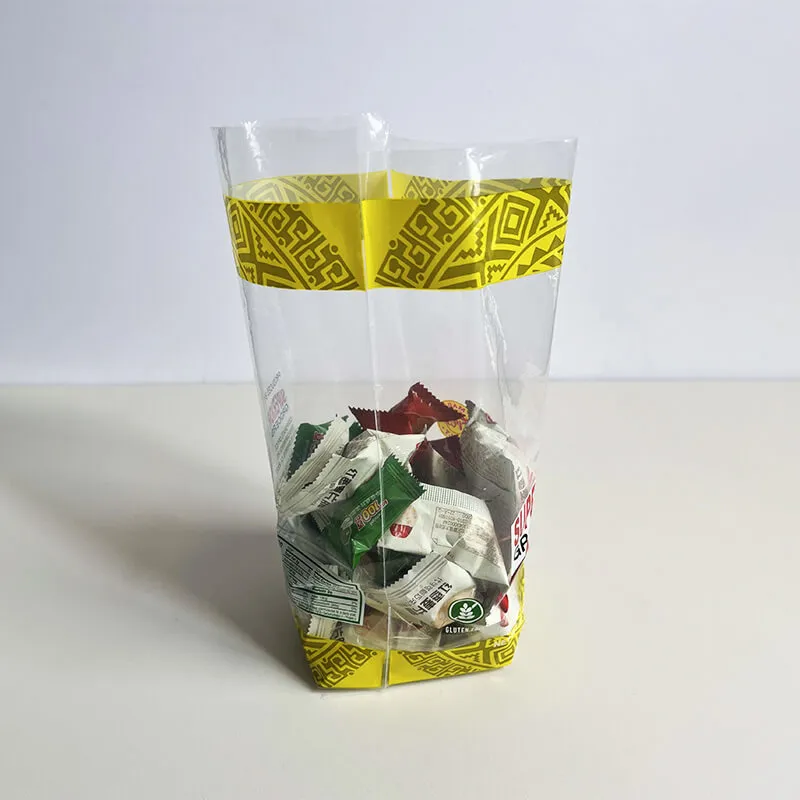
Flat bottom food bags are made of LDPE material and have a flat bottom support design. The production process is different from traditional plastic bags or other composite flat bottom bags, mainly in terms of material selection, bag making process, heat sealing technology, etc.:
1. Material selection (LDPE)
Low-density polyethylene (LDPE): good flexibility, high transparency, suitable for food packaging, and the material meets food grade standards (such as FDA certification).
Thickness control: usually 40-120μm, it needs to be extruded evenly to avoid being too thin and easy to break or too thick to affect the cost.
2. Bag making process (flat bottom bag forming)
The core process of flat bottom bags is bottom heat sealing + side folding to make it stand upright. The specific steps include:
(1) Film unwinding & printing (optional)
If printing is required (such as brand LOGO), flexographic printing or gravure printing is used, but the printing adhesion of single-layer LDPE needs special treatment (corona treatment improves ink adhesion).
(2) Bottom heat sealing (key step)
Heat sealing method: Use heat pressure sealing to form a flat bottom structure.
First fold the film in half and heat seal the two sides (to form a tube).
The bottom is pressed by a heat sealing knife to form an "M-shaped" or "envelope-style" bottom seal to ensure standing stability.
Temperature control: The heat sealing temperature of LDPE is usually 110-150℃, which needs to be precisely controlled to avoid melting through or loose sealing.
(3) Side folding (Gusset treatment, optional)
If you need to increase the capacity, you can make folding gussets (Side Gusset) on both sides, but the folding part of the single-layer LDPE is easy to wear and tear, so the heat sealing strength needs to be strengthened.
(4) Flat mouth treatment (no sealing)
The bag mouth remains open (flat mouth), and then heat-sealed or sealed by a sealing machine after the customer fills the food.
3. Heat seal strength and sealing test
Heat seal strength test: Ensure that the bottom and side seals can withstand the weight of the contents (such as nuts, powder, etc.). Leakage/liquid leakage test: The sealing performance of single-layer LDPE is not as good as that of composite film, and strict testing is required (especially for powder or fine particles).
4. Environmental protection and special process (optional)
Degradable LDPE: If the customer requires environmental protection, oxidative degradation agent (such as d2w) can be added, but the degradation conditions must be indicated.
Antistatic treatment: used for powder food packaging to prevent static adsorption.