Introduction
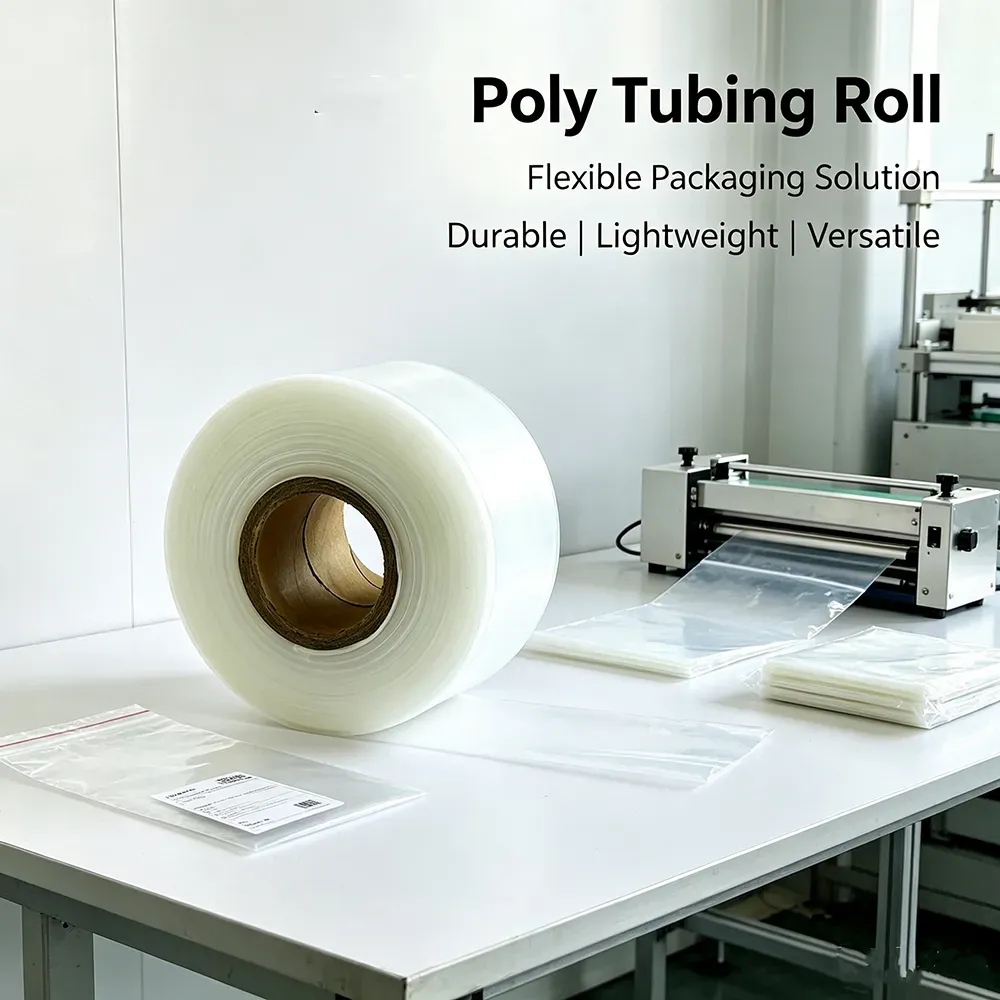
A heavy duty poly tubing roll is a continuous tubular plastic film commonly used for industrial packaging, product protection, storage, shipping, and custom-size packaging. Unlike pre-made plastic bags, poly tubing does not come with a permanently closed bottom or top. Instead, users can cut the tubing to the required length and seal the ends after placing the product inside.
One of the most common questions when using heavy duty poly tubing is: How are both ends sealed?
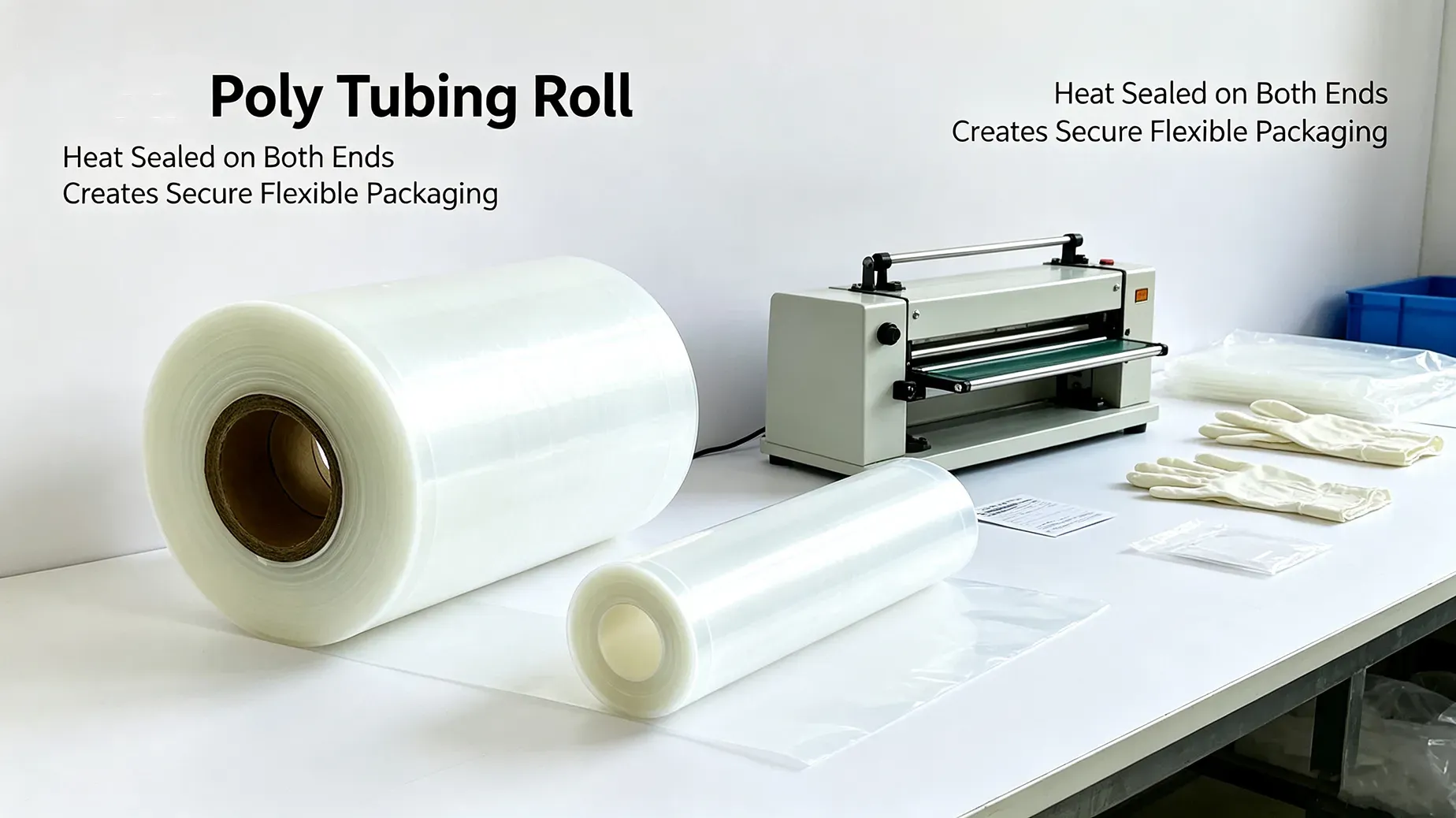
In most applications, both ends are sealed using heat sealing equipment. The polyethylene film is heated to a suitable temperature, pressed together, and then cooled to create a strong and reliable closure. Depending on the application, other sealing methods may also be used.
Understanding the correct sealing process is important because the quality of the end seals directly affects package strength, product protection, and overall packaging performance.
What Is a Heavy Duty Poly Tubing Roll?
A heavy duty poly tubing roll is a continuous tube made from polyethylene film. Common materials include LDPE, LLDPE, and HDPE, depending on the required strength, flexibility, transparency, and sealing performance.
The tubing is supplied on a roll rather than as individual bags. This design allows users to create packages with different lengths without purchasing multiple fixed-size bags.
For example, if a product is 30 inches long, the user can pull out enough tubing to cover the product, cut it to the appropriate length, and seal both ends.
The heavy duty construction is particularly useful for products that are heavier, larger, sharp-edged, or exposed to demanding handling conditions.
Why Does Heavy Duty Poly Tubing Need Two End Seals?
Unlike a conventional plastic bag, tubing has two open ends when it is cut from the roll. To turn the tubing into a closed package, both ends must eventually be sealed.
The sealing process provides several important functions.
Product Protection
A properly sealed package can help protect products from dust, dirt, moisture, and handling during transportation and storage.
Package Strength
For heavy or bulky products, a strong end seal helps prevent the package from opening when the product is lifted or moved.
Customized Package Length
Because the tubing can be cut at different lengths, the package can be customized for each product.
Improved Packaging Efficiency
One tubing roll can replace multiple fixed-size bags for some applications, reducing the number of packaging sizes that need to be stored.
How Are Both Ends of a Heavy Duty Poly Tubing Roll Sealed?
The most common method is heat sealing.
The basic process is:
Pull the tubing → Cut to length → Seal one end → Insert the product → Seal the second end
Alternatively, the product can be inserted first and both ends can then be sealed.
The exact process depends on the product, packaging line, equipment, and production requirements.
Step 1: Pull the Required Length of Tubing
The operator first pulls the required amount of heavy duty poly tubing from the roll.
The required length depends on the product dimensions and the amount of material needed for sealing.
It is important to leave enough extra tubing at both ends. If the tubing is cut too short, there may not be enough material to create a reliable heat seal.
Step 2: Cut the Tubing
After measuring the required length, the tubing is cut using a knife, cutting blade, or integrated cutting system.
For manual packaging, the operator may use a separate cutting tool.
For industrial production, automatic packaging equipment can measure, cut, and seal the tubing automatically.
The cutting edge should be reasonably straight because an uneven edge can make sealing more difficult.
Step 3: Seal the First End
After cutting the tubing, one end can be sealed using a heat sealer.
The two layers of polyethylene film are placed between the sealing bars.
The machine applies heat and pressure to the film. The polyethylene softens or melts at the sealing area, and the two film layers bond together.
After sufficient cooling, the seal becomes a closed edge.
This creates the first end of the custom bag.
Step 4: Insert the Product
Once one end is sealed, the product is inserted through the remaining open end.
The product should fit comfortably inside the tubing.
For heavy-duty applications, sharp corners should be handled carefully because excessive pressure against the film can cause punctures even when the end seal itself is strong.
If necessary, protective materials can be placed around sharp edges before sealing.
Step 5: Seal the Second End
After the product has been positioned inside the tubing, the remaining open end is placed into the sealing machine.
The machine applies heat and pressure again to create the second end seal.
The finished package is now closed on both ends.
The basic structure is:
Heat Seal → Product → Heat Seal
This is the simplest and most common way to convert a continuous tubing roll into an individual package.
What Equipment Is Used to Seal Heavy Duty Poly Tubing?
Different sealing machines can be used depending on the packaging volume and film thickness.
Impulse Heat Sealer
An impulse heat sealer is commonly used for manual or small-batch packaging.
The sealing bar heats the polyethylene film for a controlled period and then cools it under pressure.
This equipment is relatively simple and suitable for many general packaging applications.
Constant Heat Sealer
Constant heat sealers maintain a continuous sealing temperature.
They can be useful for certain thicker films and continuous packaging operations.
Automatic Heat Sealing Machine
For high-volume production, automatic equipment can perform several operations, including:
Film feeding
Product insertion
Film cutting
Heat sealing
Package discharge
This can improve production speed and packaging consistency.
Side Sealing Machine
Some industrial packaging systems use side-sealing technology to cut and seal film continuously.
This is useful when packaging operations require higher production efficiency.
What Temperature Is Used to Seal Heavy Duty Poly Tubing?
There is no single heat-sealing temperature that works for every heavy duty poly tubing roll.
The correct sealing parameters depend on:
Film material
Film thickness
Polyethylene formulation
Machine type
Sealing bar design
Sealing pressure
Dwell time
Cooling time
For example, LDPE, LLDPE, and HDPE may require different processing conditions.
Therefore, users should follow the film manufacturer's recommendations and perform sealing tests before starting full production.
Too little heat may result in a weak seal.
Too much heat may cause film deformation, excessive melting, shrinkage, or a damaged sealing area.
How Strong Is the End Seal?
The strength of the finished seal depends on both the film and the sealing process.
A high-quality heavy duty poly tubing roll should be matched with suitable sealing equipment.
Important factors include:
Film Thickness
Thicker film can provide a stronger overall package structure, but it may require appropriate sealing settings.
Material
LDPE and LLDPE generally offer good heat-sealing characteristics. HDPE can also be heat sealed when suitable grades and equipment are used.
Seal Width
A wider seal may provide greater sealing area, depending on the application.
Heat and Pressure
The correct combination of heat, pressure, and sealing time is essential.
Cooling
Allowing the seal to cool under pressure can improve seal integrity.
Common Problems When Sealing Heavy Duty Poly Tubing
Even with a suitable machine, sealing problems can occur.
Weak Seal
A weak seal may result from insufficient heat, inadequate pressure, short dwell time, or contamination.
Burned Film
Excessive heat can damage the polyethylene film and create a brittle or distorted sealing area.
Wrinkled Seal
Wrinkles can prevent the sealing surfaces from contacting evenly.
The film should be positioned flat and smoothly before sealing.
Contaminated Seal
Dust, oil, moisture, product particles, or other contaminants between the film layers can reduce seal strength.
The sealing area should be kept clean.
Uneven Sealing
If the sealing bar does not apply consistent pressure, the seal may be stronger in some areas and weaker in others.
How to Improve the Sealing Quality of Heavy Duty Poly Tubing
For consistent packaging results, several practices are recommended.
Use the Correct Film
Choose a heavy duty poly tubing roll with the appropriate thickness and material for the product.
Test the Seal Before Production
Perform sample sealing tests before running a large production order.
Keep the Sealing Area Clean
Remove dust, oil, moisture, and product particles from the sealing area.
Maintain the Equipment
Inspect heating elements, sealing bars, pressure mechanisms, and temperature controls regularly.
Use Consistent Parameters
Once the correct heat, pressure, and sealing time have been established, maintain consistent machine settings.
Inspect Finished Packages
Randomly test sealed packages for seal integrity, tearing, leakage, and mechanical strength.
Can Both Ends Be Sealed Automatically?
Yes.
In high-volume packaging operations, automatic machinery can feed the heavy duty poly tubing roll, measure the required length, insert or receive the product, cut the film, and seal the ends.
Automation is particularly useful for factories packaging large quantities of products with similar dimensions.
Automatic systems can reduce manual labor and improve consistency.
For products with highly variable dimensions, semi-automatic systems may provide a better balance between flexibility and production efficiency.
Applications of Heavy Duty Poly Tubing with Heat-Sealed Ends
Heat-sealed poly tubing is widely used for:
Industrial components
Metal parts
Machinery
Furniture components
Long profiles
Construction materials
Electrical products
Hardware
Large products
Warehouse storage
Shipping protection
Manufacturing packaging
The ability to adjust the package length makes tubing especially useful for products that do not fit standard bag dimensions.
Heavy Duty Poly Tubing Roll vs. Pre-Made Poly Bags
The biggest difference is packaging flexibility.
Pre-made poly bags are manufactured in fixed sizes. If a company has products measuring 20, 30, and 40 inches, it may need three different bag sizes.
With a heavy duty poly tubing roll, the operator can cut different lengths from the same roll.
This can simplify inventory management and provide more flexibility for custom packaging.
However, pre-made bags may be more convenient when products have standardized dimensions and high-speed packaging is required.
The best option depends on the product dimensions, packaging volume, labor requirements, and available equipment.
Conclusion
A heavy duty poly tubing roll is sealed at both ends primarily through heat sealing. The continuous polyethylene tube is first cut to the required length, one end is sealed, the product is inserted, and the remaining open end is sealed.
The basic process can be summarized as:
Measure → Cut → Heat Seal → Insert Product → Heat Seal → Inspect
The quality of the finished package depends on the film material, thickness, sealing temperature, pressure, dwell time, cooling, and equipment condition.
For small-volume applications, manual impulse heat sealers may be sufficient. For large-scale manufacturing, automatic cutting and sealing systems can improve production efficiency and consistency.
When choosing a heavy duty poly tubing roll, businesses should consider the product weight, dimensions, surface characteristics, required protection, film material, thickness, and sealing method.
With the correct combination of film and sealing equipment, heavy duty poly tubing can provide a flexible and durable packaging solution for industrial, commercial, shipping, and storage applications.