

Zipper bags are widely used in food packaging, retail packaging, industrial packaging, and everyday storage. Their resealable closure allows users to open and close the bag multiple times while keeping the contents protected from dust, moisture, and external contamination.
When choosing resealable plastic bags, one important consideration is the zipper closure structure. Some bags feature a single zipper track, while others use a double zipper track. Although both designs provide reusable sealing functions, they differ in closure structure, sealing reliability, usability, and suitable applications.
Understanding the differences between single zipper bags and double zipper bags helps buyers select the right packaging solution based on product characteristics, storage requirements, and budget.

1. What Are Single Zipper Bags?
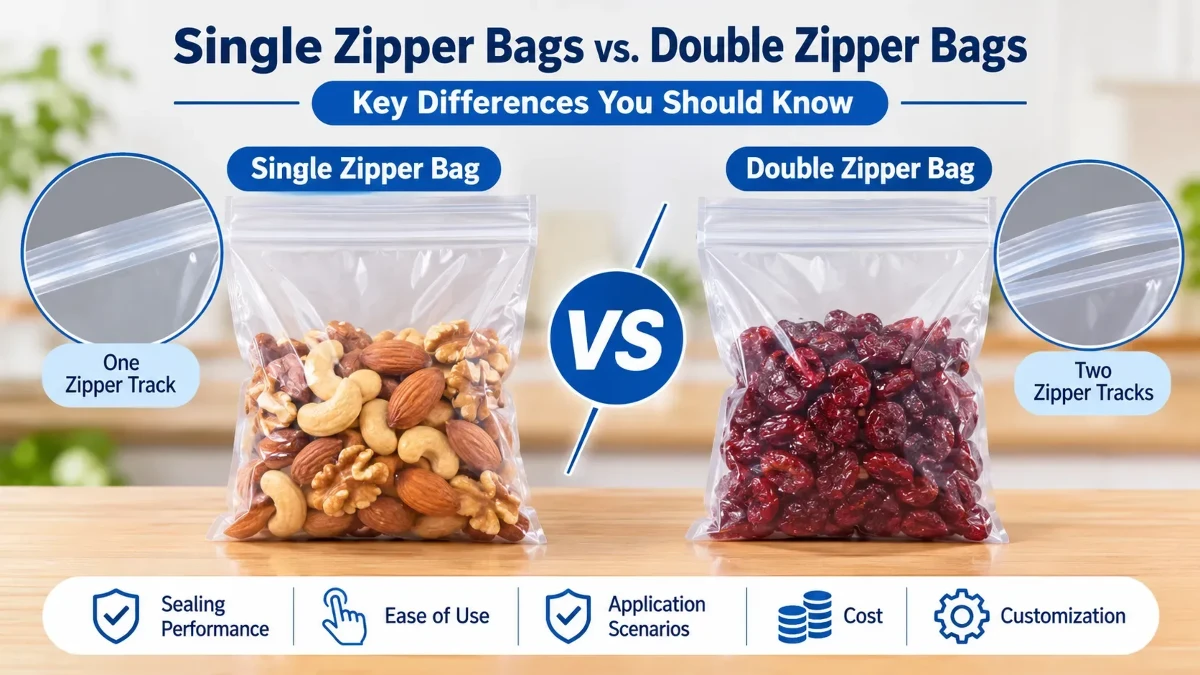
Single zipper bags are resealable plastic bags equipped with one interlocking zipper track at the opening. The zipper consists of two matching profiles: one side has a raised ridge, while the other has a corresponding groove. When pressed together, these profiles form a closure that helps keep the bag securely sealed.
Single zipper bags are popular because of their simple structure, convenient operation, and relatively economical production cost.
Key Features of Single Zipper Bags
Simple Closure Structure: One zipper track provides a straightforward sealing solution.
Easy Operation: Users can open and close the bag by pressing or pulling the zipper profiles.
Cost-Effective: The simpler construction generally requires less material and processing.
Versatile Applications: Suitable for packaging food, accessories, stationery, and household products.
Customizable Design: Available in different sizes, thicknesses, materials, and printing options.
Single zipper bags are commonly selected for products that require convenient daily storage and ordinary resealable packaging.
2. What Are Double Zipper Bags?
Double zipper bags are resealable plastic bags equipped with two parallel zipper tracks at the opening. Instead of relying on one interlocking closure, this design provides two separate sealing points.
The additional zipper track creates a more secure closure structure and can help reduce the risk of accidental opening during handling, transportation, and storage.
Double zipper bags are particularly suitable for products that require additional closure reliability or frequent opening and closing.
Key Features of Double Zipper Bags
Dual Closure Structure: Two zipper tracks provide two sealing points.
Improved Closure Reliability: The additional track offers extra protection against accidental opening.
Better Containment: Can help reduce the risk of dry contents, such as powders and small particles, escaping through an imperfect closure.
Reusable Design: Suitable for products that need repeated access.
Custom Manufacturing: Different zipper profiles, bag dimensions, film thicknesses, and printing designs can be customized.
It is important to understand that double zipper closures do not automatically make a bag airtight or completely leakproof. Actual performance depends on zipper design, film quality, manufacturing precision, and proper closure.
3. Single Zipper Bags vs. Double Zipper Bags: Key Differences
Although both types of bags use interlocking plastic profiles, their closure structures create different packaging characteristics.
| Comparison | Single Zipper Bags | Double Zipper Bags |
|---|---|---|
| Zipper Structure | One zipper track | Two parallel zipper tracks |
| Sealing Points | One | Two |
| Closure Reliability | Suitable for general packaging | Provides additional closure security |
| Ease of Use | Simple and convenient | Requires closing two tracks |
| Dust Protection | Basic protection | Additional closure protection |
| Moisture Protection | Depends on bag construction | Depends on bag construction and closure quality |
| Powder Containment | Suitable for ordinary applications | Can provide additional protection |
| Production Cost | Generally lower | Generally higher |
| Typical Applications | General storage and packaging | Applications requiring more reliable closure |
The main difference is the number of sealing tracks. Double zipper bags offer an additional closure point, but this does not mean they are always the better choice.
For ordinary packaging applications, a single zipper bag may provide sufficient performance at a more economical cost. For products that require extra closure security, a double zipper design may be worth considering.
4. Applications of Single Zipper Bags
Single zipper bags are widely used across different industries because of their practical structure and economical packaging performance.
Food Packaging
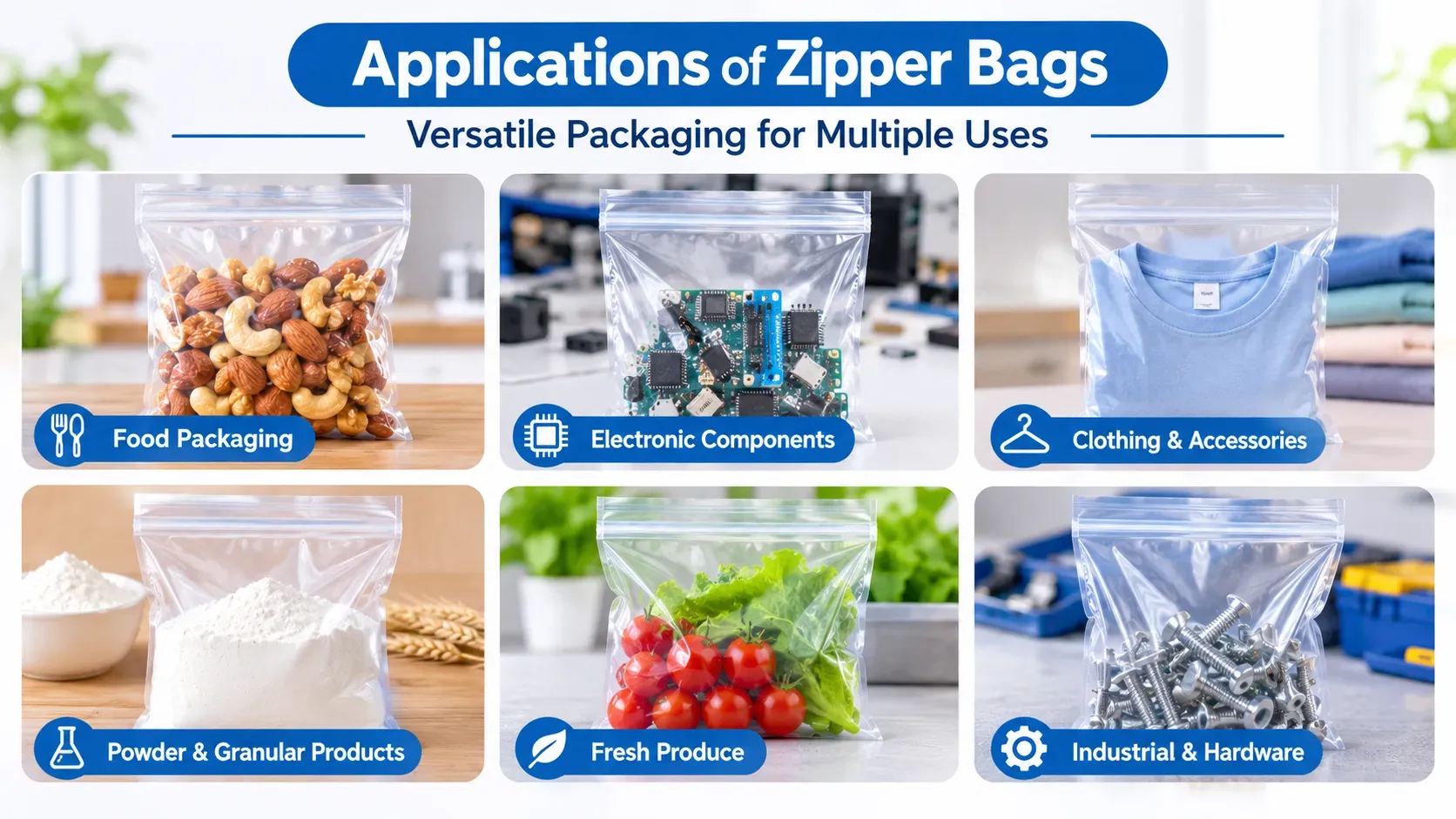
Single zipper bags are suitable for packaging dry foods such as biscuits, nuts, snacks, dried fruits, and other food products. Food-contact materials should be selected according to the applicable market regulations and intended use.
Retail and Accessory Packaging
Small accessories, buttons, jewelry components, electronic parts, and hardware products can be stored in single zipper bags. Transparent films also make product identification easier.
Household Storage
Consumers use single zipper bags to organize stationery, small tools, personal items, and household accessories. Their resealable design helps keep stored items organized.
Industrial Packaging
Manufacturers and distributors use single zipper bags to package small components, spare parts, samples, and other lightweight products.
5. Applications of Double Zipper Bags
Double zipper bags are suitable for applications where additional closure security is preferred.
Powder and Granular Products
Double zipper closures can provide an additional barrier against the accidental escape of dry powders, granules, and small particles. They are useful for certain food ingredients, pet food samples, and industrial materials.
Repeated Food Storage
For snacks, nuts, dried fruits, and other products that consumers open and close repeatedly, double zipper bags offer an additional closure point.
Pet Food Packaging
Small and medium-sized pet food packaging may benefit from a double zipper structure, particularly when the contents are used over multiple occasions.
Industrial and Electronic Components
Small industrial parts, accessories, and electronic components can be packaged in double zipper bags when buyers want additional closure security during handling and storage.
6. Materials Used for Single and Double Zipper Bags
The material selection affects bag strength, flexibility, transparency, moisture resistance, and overall packaging performance.
Common materials include:
LDPE (Low-Density Polyethylene)
LDPE is widely used for resealable bags because it offers good flexibility, softness, and impact resistance. It is suitable for general-purpose zipper bags.
HDPE (High-Density Polyethylene)
HDPE provides greater stiffness and a different tactile feel compared with LDPE. It can be selected for applications requiring a firmer bag structure.
PP (Polypropylene)
PP films offer good transparency and stiffness. They are suitable for packaging applications where product visibility is important.
PE Co-Extruded Films
Multi-layer PE films can combine different material properties to improve flexibility, strength, and functional performance.
Laminated Materials
For products requiring enhanced barrier properties, laminated structures may be considered. The material combination should be selected according to the required oxygen, moisture, and aroma barrier performance.
Both single and double zipper bags can be manufactured using different film structures, depending on the intended application.
7. What Should Buyers Consider When Choosing Zipper Bags?
Choosing between single zipper bags and double zipper bags requires more than simply comparing the number of zipper tracks.
Product Characteristics
Consider whether the packaged product is solid, powdery, granular, oily, or moisture-sensitive. Product characteristics directly influence the required packaging structure.
Sealing Requirements
If the product only needs basic resealable storage, a single zipper may be sufficient. If additional closure reliability is important, a double zipper structure can be considered.
Bag Thickness and Strength
Film thickness should match the product weight, packaging dimensions, and transportation conditions. A double zipper does not automatically make the entire bag stronger.
Opening Frequency
For products that are accessed frequently, evaluate how easily consumers can open and close the zipper. The zipper profile should offer a suitable balance between sealing performance and usability.
Packaging Cost
Single zipper bags are generally more economical because of their simpler construction. Double zipper bags may involve additional material and processing costs.
Customization Requirements
Buyers should also consider bag width, length, bottom structure, printing, hanging holes, rounded corners, and other customized features.
8. Custom Single and Double Zipper Bags from a Plastic Packaging Manufacturer
Working with an experienced plastic packaging manufacturer helps buyers develop zipper bags that match their product requirements and market positioning.
At GOINPACK, customized resealable plastic bags can be developed according to customer specifications, including:
Materials: LDPE, HDPE, PP, PE co-extruded films, and customized laminated structures.
Closure Options: Single zipper tracks and double zipper tracks.
Thickness: Customized film thickness according to product weight and application.
Dimensions: Custom widths, lengths, and gusset options.
Printing: Custom logos, product information, brand colors, and promotional designs.
Packaging: Customized packing quantities and carton specifications.
Quality Control: Inspection of film appearance, dimensions, zipper engagement, sealing performance, and printing quality.
For B2B buyers, selecting the correct zipper structure can help balance packaging functionality, customer experience, and production cost.
9. Frequently Asked Questions
Q1: What is the main difference between single zipper bags and double zipper bags?
The main difference is the number of zipper tracks. Single zipper bags have one interlocking track, while double zipper bags have two parallel tracks that provide an additional closure point.
Q2: Are double zipper bags more airtight than single zipper bags?
Not necessarily. Two zipper tracks may improve closure reliability, but neither design is automatically airtight. Airtight performance requires suitable materials, specialized sealing structures, and appropriate testing.
Q3: Are double zipper bags suitable for food packaging?
Yes. Double zipper bags can be used for food packaging when the film and zipper materials comply with the relevant food-contact requirements in the target market.
Q4: Which zipper bag is better for powder products?
Double zipper bags may be a suitable choice when additional closure security is needed to reduce powder leakage. However, the zipper structure, bag thickness, and overall manufacturing quality should also be evaluated.
Q5: Can single and double zipper bags be customized?
Yes. Both types can be customized in terms of dimensions, film thickness, material, printing, color, and packaging specifications.
Conclusion
Single zipper bags and double zipper bags are both practical resealable packaging solutions, but they serve slightly different requirements.
Single zipper bags are suitable for general-purpose storage and packaging because of their simple construction and economical cost. Double zipper bags provide an additional closure point, making them a useful option for products that require extra closure reliability and repeated access.
For packaging distributors, importers, wholesalers, and brand owners, the best choice depends on product characteristics, sealing expectations, budget, and end-user requirements. Working with a professional plastic packaging manufacturer can help ensure that the selected zipper structure meets the intended packaging application.


